01
The problem
A good-first-issue label does not tell you whether the work depends on an unfinished issue, names a missing base branch, already has a contributor, or overlaps a pull request. Discovering those blockers after setting up a development environment wastes time.
02
How it works
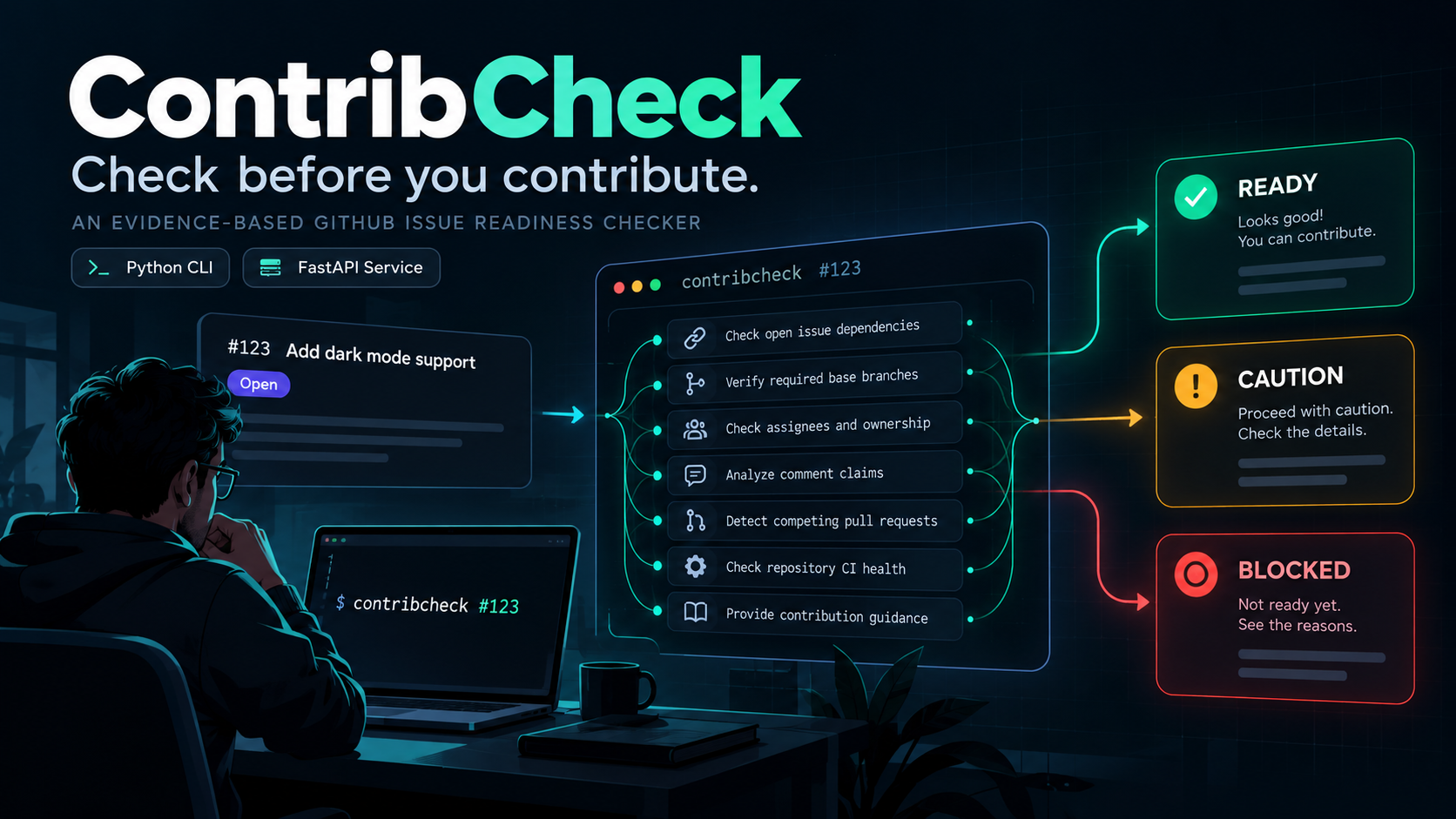
- Inspect issue state, dependencies, explicit base-branch requirements, and current assignments.
- Look for work claims in comments, competing pull requests, contribution guidance, and repository health.
- Check the latest completed default-branch workflows and report maintainer-response evidence.
- Return ready, caution, or blocked with linked evidence and next actions. A signal that cannot be verified stays unknown instead of silently passing.
03
Using the tool
ContribCheck is published as a Python CLI, with an SDK and optional FastAPI service. It can produce terminal, JSON, and Markdown reports, or return a non-zero exit code when a configured readiness threshold is reached. Public metadata can be inspected without authentication, subject to GitHub rate limits.
04
What the verdict means
Readiness is an assessment of observable prerequisites, not a prediction that a maintainer will merge a contribution. Comments and repository state can change after inspection. Contributors still need to coordinate scope with maintainers and review the evidence themselves.
Explore the work
Source code, documentation, and reproducibility notes on GitHub