01
The observation
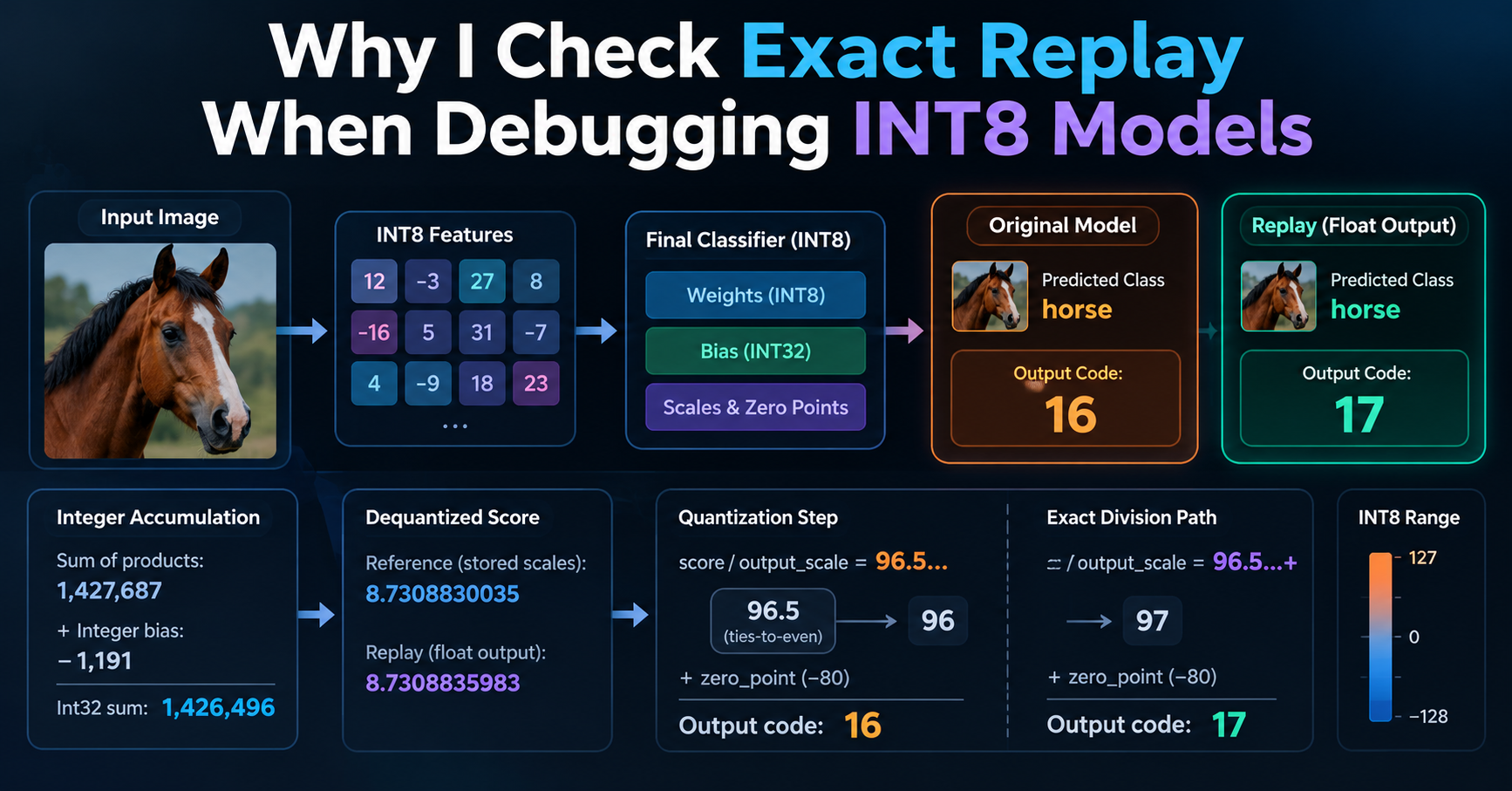
In the recorded example, the original classifier produces horse code 16 for test image 4054. A float-output replay followed by output quantization produces 17. Both still predict horse. The question is about exact numerical agreement, not a change in the predicted class.
02
The diagnostic approach
- Check the saved integer identity and dot-plus-bias totals against recorded bounds.
- Compare exact-reference and binary32 arithmetic across 33 inputs and 10 classes.
- Evaluate 14 predefined code-comparison paths and 27 rounding-boundary probes, retaining disagreements rather than relaxing tolerances.
- Optionally rerun standalone output quantization and dequantization on the recorded values.
03
What can be reproduced
The public bundle includes numerical observations, verification scripts, analysis, tests, result tables, and provenance. Its verifier regenerates and compares seven numerical result files byte for byte. The optional native check exercises standalone output quantizers, not the original fused classifier.
04
What remains unresolved
Several candidate calculations match the original codes, so the native fused calculation order remains unresolved. The release does not include original images, full models, feature arrays, or weight matrices; it cannot rerun the full classifier or reconstruct dot products from those missing inputs. This is a failure-selected educational diagnostic, not proof of a kernel bug, a universal instruction order, or an accuracy improvement.
Explore the work
Source code, documentation, and reproducibility notes on GitHub
Published companion article on Medium